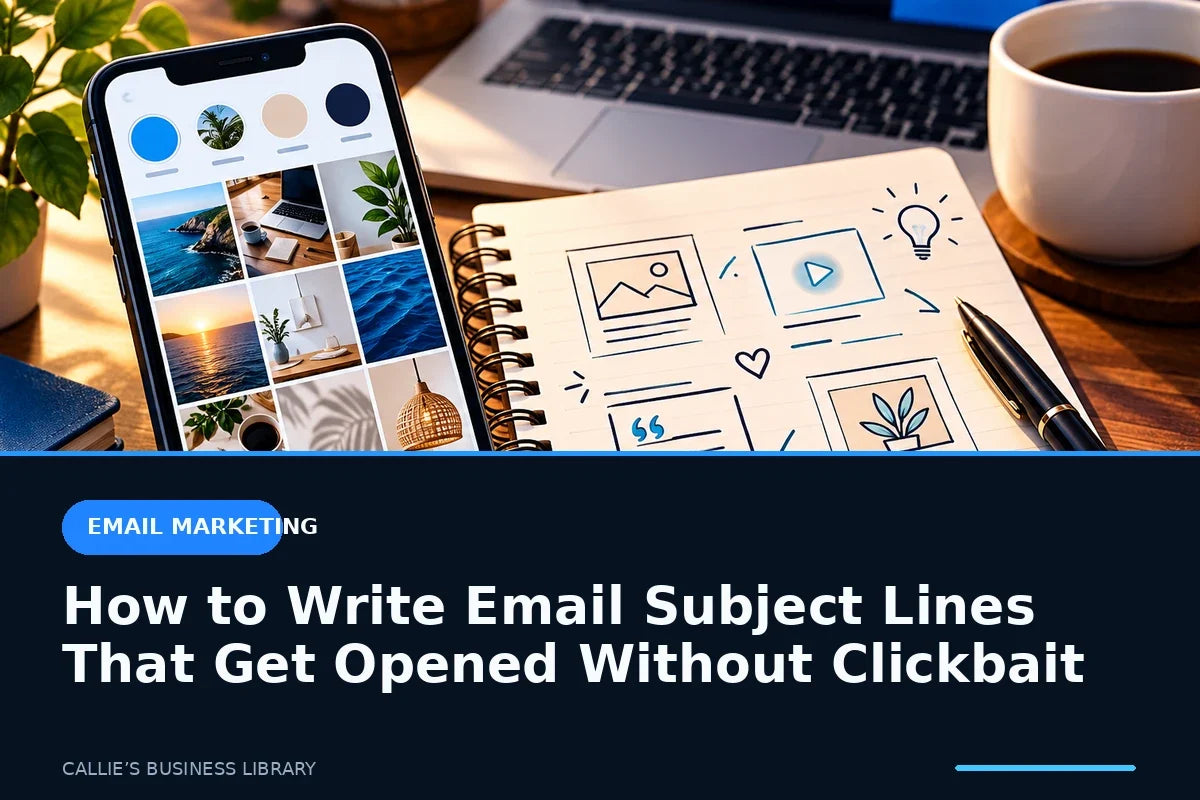
A good subject line earns attention without breaking the promise of the email.
The goal is not to trick someone into opening. It is to help the right reader recognize that the message may be useful, relevant, timely, or interesting.
Write the email before the subject line
It is easier to write an accurate subject line after you know what the email actually delivers.
Ask:
- What is the main value?
- What changed?
- What question does this answer?
- What action becomes easier after reading?
Use specificity
Specific subject lines reduce guessing.
Instead of “Big news,” try a subject that identifies what changed. Instead of “Tips for your business,” identify the problem or outcome the email addresses.
Use curiosity carefully
Curiosity works when the email resolves it.
A subject such as “The page we stopped rewriting” can work if the message genuinely explains what changed and why. Curiosity becomes clickbait when the reveal has little connection to the promise.
Lead with usefulness
Useful subject lines often tell the reader what they can learn, fix, compare, avoid, download, or decide.
Examples of structures:
- How to [solve a specific problem]
- A simple way to [desired next step]
- [Number] things to check before [action]
- What to do when [common situation]
- Your [resource] is ready
Use structures as starting points, not formulas you repeat forever.
Use urgency only when it is real
If a price, registration window, appointment, stock level, or deadline genuinely changes, timing may belong in the subject line.
Do not manufacture a countdown the business is not actually honoring.
Match the relationship
A new subscriber may need more context. A customer waiting for an update may understand a shorter subject immediately.
The more the sender knows about the subscriber’s current context, the less generic the subject line needs to be.
Avoid misleading reply language
Do not make a promotional email look like an existing personal conversation if it is not one.
Trust is worth more than one accidental open.
Keep the sender identity recognizable
The subject line is only part of the inbox decision. The sender name and previous relationship matter too.
A strong subject line cannot permanently compensate for emails that repeatedly disappoint the reader.
Test ideas, not gimmicks
If your email platform supports testing, compare meaningful approaches such as benefit versus question, specific versus broad, short versus descriptive, or resource-led versus problem-led.
Do not treat one winner as a permanent law. Audience, topic, timing, and message all change.
Do not judge the subject line by opens alone
Privacy features and inbox behavior can make open data imperfect. More importantly, the open is not the final business outcome.
Look at clicks, replies, conversions where appropriate, unsubscribes, and what happens after the reader enters the customer path.
Use Email Marketing Metrics for Small Business for the broader measurement framework.
A five-question subject-line review
- Does it accurately represent the email?
- Is the value, question, or relevance understandable?
- Would the right reader recognize why this matters?
- Is any urgency truthful?
- Does the email itself deliver on the subject?
Subject lines are packaging. The email still has to deserve the open.
For the broader email system, return to Email Marketing for Small Business: A Beginner’s Guide.