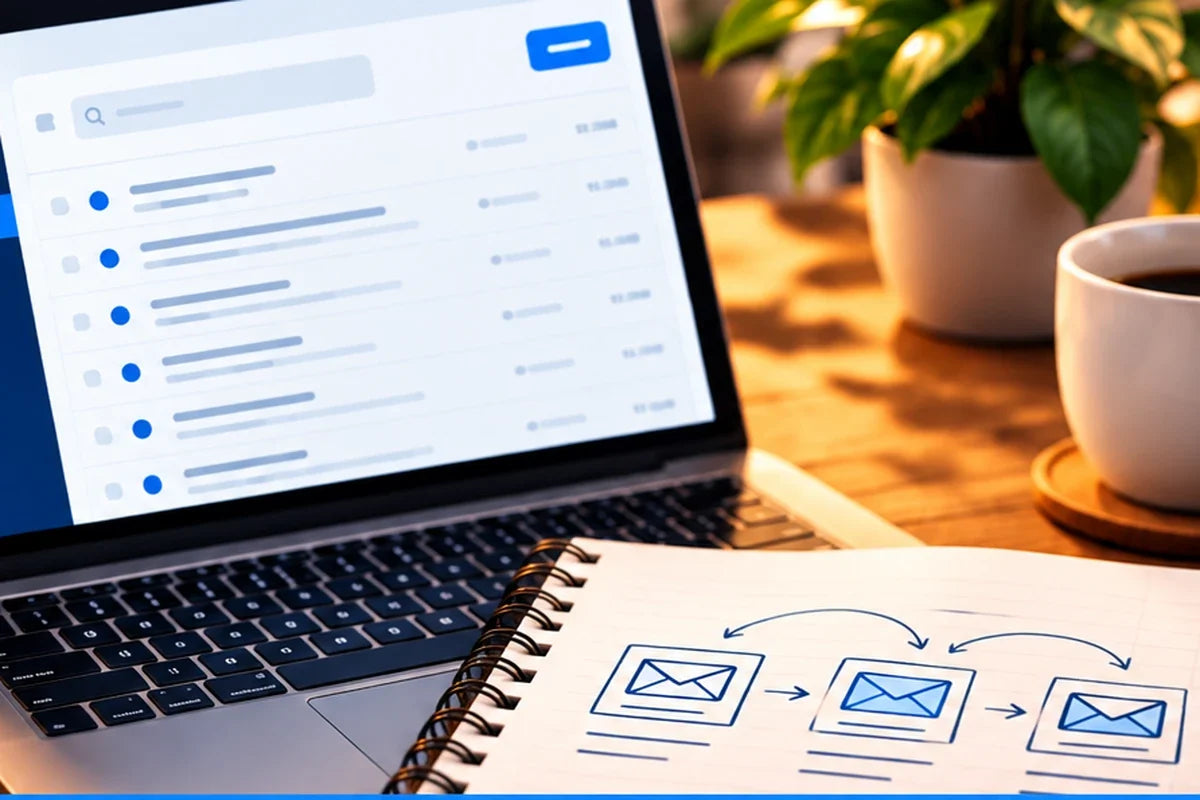
A welcome email sequence is your chance to help a new subscriber understand what they joined, what you can help them with, and where they should go next.
It does not need to be complicated.
Email 1: Deliver and orient
Send what you promised immediately when possible.
Then explain:
- what they received
- where to find it
- what kind of emails they can expect
- one useful next step
Do not bury the promised resource beneath three paragraphs of brand history.
Email 2: Solve one small problem
Teach something immediately useful related to why they subscribed.
This proves the relationship is not going to be a nonstop sales broadcast.
Email 3: Help them see the bigger problem
Explain the pattern behind the issue they are trying to solve.
For example, somebody who downloaded a content checklist may think the problem is “I need more post ideas,” when the deeper problem may be that their content has no defined job.
Email 4: Show the process
Give the reader a practical framework, checklist, or example.
Make the method feel understandable instead of mysterious.
Email 5: Offer the logical next step
If you have a relevant product or service, this is a natural place to explain it.
Focus on the connection between the reader’s problem and what the offer helps them implement.
If there is no relevant paid offer, point them to another free resource.
Keep each email focused
One email can contain multiple supporting points, but it should still have one primary job and one primary next step.
Write subject lines after the email
Once the email is clear, write a subject line that accurately earns the open.
Avoid tricking the reader into opening with a subject line that the email does not deliver on.
Review the sequence as one journey
Read the emails in order and ask:
- Does each message build on the previous one?
- Are we repeating ourselves?
- Does the subscriber understand what to do next?
- Is the offer introduced at a relevant moment?
- Are expectations clear?
Welcome sequence formula
DELIVER → HELP → CONTEXT → PROCESS → NEXT STEP
That is enough to create a welcome experience that respects the reader and gives the relationship somewhere to go.
Continue after the welcome sequence
Once the subscriber is oriented, connect the relationship to a sustainable ongoing system.
- Email Marketing for Small Business: A Beginner’s Guide maps the complete system.
- How to Write Email Subject Lines That Get Opened Without Clickbait helps package each message accurately.
- Email Segmentation for Small Business helps you decide when different subscribers need different next steps.