If you run a small business, you probably did not decide one morning that you wanted a second career as your own marketing department.
Yet that is what happens.
You are the owner, strategist, copywriter, social media manager, email marketer, researcher, campaign planner, SEO person, creative director, and quality-control department—sometimes before lunch.
Then AI arrives and promises to make everything easier.
At first, it does. You ask ChatGPT for a caption, an email, a blog outline, or a marketing idea and get something useful in seconds.
But after the novelty wears off, another problem appears:
You keep having to explain your business again.
Who you serve. What you sell. Your tone. Your offer. Your price. Your values. What you already decided last week. What you never want your marketing to sound like. Which ideas have already been rejected. Which campaign is currently running.
The AI is fast. The repeated setup is not.
That is the difference between using AI for marketing and building an AI marketing system.
The real problem is not usually the prompt
When people get generic AI output, the first advice they hear is usually, “Write a better prompt.”
Sometimes that helps. But there is a limit.
If every task begins with a blank chat and a blank understanding of your business, even an excellent prompt is still rebuilding the foundation.
A small-business owner might write:
Create five Instagram captions for my business.
The AI can technically do that. But it does not automatically know which customer you are trying to reach, what you are selling this month, what language your audience responds to, what you posted yesterday, what your brand refuses to promise, or whether the goal is awareness, leads, or sales.
So you add more instructions. Then more. Then next week, you do it again.
That is not a content problem. It is a context and workflow problem.
What a better AI marketing workflow looks like
A useful AI marketing workflow has three layers.
1. Business context
This is the information that should not need to be reinvented every time:
- what the business does
- who it serves
- the core offer
- positioning
- brand voice
- proof and claims you can support
- current pricing and promotions
- customer objections
- content rules
- channels you use
- goals and priorities
Think of this as the AI’s operating context.
2. The current objective
Once the foundation exists, the owner should be able to start with the thing that actually matters now:
Build this week’s campaign around the new offer.
Turn this customer question into a blog article and three social posts.
Review the traffic spike and tell me where visitors dropped out of the funnel.
Create the next email in the sequence.
The objective changes. The business foundation does not.
3. Human approval
AI can research, organize, draft, compare, recommend, and execute many repeatable steps.
But the owner should still control consequential decisions such as public claims, pricing, promotions, guarantees, spending, permanent brand decisions, and sensitive customer communication.
The clean workflow is not “AI does everything.”
It is:
Give the objective → let the system do the working steps → approve or adjust → continue.
Why small businesses feel overwhelmed by AI tools
The AI-tool market has created a strange situation.
A business owner can now subscribe to one tool for captions, another for SEO, another for email, another for images, another for competitor research, another for analytics, and another for automation.
Every individual tool may save time.
Collectively, they can create a new job: managing the tools.
One tool does not know what another tool decided. Brand voice drifts. Information gets copied between tabs. Work gets generated faster than it gets finished.
The answer is not necessarily another specialized app. The answer is a shared operating system for the work.
A simple AI marketing system for a one-person business
Step 1: Create one business reference
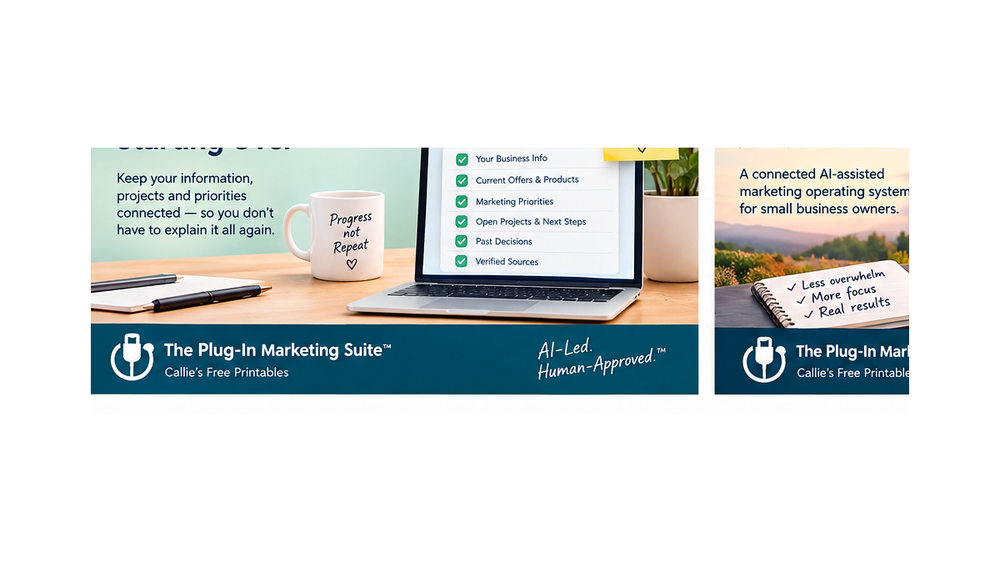
Write one source of truth containing your business description, target customer, offer, pricing, positioning, tone, brand rules, testimonials or proof, frequently asked questions, and current priorities.
Keep it concise enough to use but specific enough to prevent generic output.
Step 2: Separate permanent truth from temporary campaigns
Your core positioning should not be buried inside a random campaign prompt.
Keep permanent business information separate from temporary items such as this week’s promotion, a seasonal campaign, a one-off event, or a new creative test.
This prevents a temporary idea from accidentally becoming permanent brand context.
Step 3: Use workflows instead of isolated prompts
A prompt asks for an output. A workflow moves a project forward.
For example, instead of simply saying “Write a blog post,” use a process:
- identify search intent
- inspect competitors
- choose the angle
- create the outline
- draft the article
- fact-check claims
- optimize the title and summary
- add internal links
- repurpose the article for social and email
- review the results later
Now AI is helping operate the process instead of simply producing text.
Step 4: Define approval gates
Decide in advance what AI can move forward without asking and what requires your approval.
That makes automation useful without making it reckless.
A practical rule for many small businesses is: AI prepares. The owner approves anything consequential.
Step 5: Save what worked
A good marketing system should get smarter because the business learns.
When a headline works, preserve it. When a customer objection keeps appearing, add it to the reference. When a campaign fails, record the lesson. When a new offer replaces an old one, update the source of truth.
Otherwise, the AI may be fast while the business itself keeps forgetting.
What should you actually use ChatGPT for?
For most small businesses, ChatGPT is strongest when it reduces thinking and production time around work that still benefits from human judgment.
Useful examples include:
- customer and competitor research
- positioning options
- content planning
- campaign briefs
- social drafts
- email sequences
- landing-page drafts
- blog outlines and first drafts
- FAQ development
- repurposing one idea across channels
- analyzing performance data you provide or connect
- documenting what the business learned
The highest-value use is often not “write more content.” It is reduce the amount of repeated work required to move from decision to execution.
What should stay human?
Small-business marketing is personal. Customers often buy because they trust the person, story, expertise, or point of view behind the business.
Keep humans firmly involved in final factual verification, sensitive claims, customer promises, major pricing decisions, ethical judgment, brand personality, personal stories, and high-stakes customer conversations.
AI-Led does not have to mean AI-controlled.
The strongest setup is often human-approved AI execution.
How to know whether your AI setup is actually working
Do not measure success by how many drafts the AI produces.
Measure what disappears from your workload and what improves in the business.
Ask:
- Am I spending less time repeating information?
- Are projects getting finished faster?
- Is our messaging more consistent?
- Are we publishing work that connects to an actual objective?
- Can I see what was approved and why?
- Are traffic, leads, add-to-carts, checkouts, or sales improving?
More output is not automatically more marketing.
Completed, connected work is the goal.
The bigger shift: from prompting to operating
The first phase of small-business AI was about prompts.
“Give me a prompt for this.” “Give me a prompt for that.”
Prompts still matter. But the bigger opportunity is what comes next: systems that remember the business context, work through repeatable steps, preserve decisions, and keep the owner in control.
That changes the owner’s role.
Instead of spending the day rebuilding instructions, you spend more time making decisions:
Yes, continue.
No, change that.
I like option two.
Do not publish that yet.
Move forward.
That is a much more useful relationship with AI.
A practical starting checklist
Before buying another AI marketing tool, make sure you have:
- one clear business reference
- one defined customer
- one current business objective
- a repeatable marketing workflow
- human approval gates
- a place to store decisions and results
- analytics that tell you whether the work is helping
If those pieces are missing, another subscription may simply add another tab.
If they are present, AI starts becoming leverage.
Keep building your AI marketing system
If you want to turn these ideas into a repeatable operating process, read How to Build an AI Marketing Workflow for a One-Person Business.
If the repeated-background problem is your biggest frustration, use How to Give ChatGPT Your Business Context Once and Reuse It to build the reusable source of truth behind the workflow.
Where The Plug-In Marketing Suite™ fits
We built The Plug-In Marketing Suite™ around this exact problem: small-business marketing should not restart from zero every time you ask AI to help.
The Suite is designed to give your marketing work reusable business context, connected workflows, and clear human approval points so you can start with the objective instead of rebuilding the backstory.
Less prompting. More operating.
If that is the experience you have been trying to create with AI, see The Plug-In Marketing Suite™ here.
Frequently asked questions
Is ChatGPT good for small business marketing?
Yes, especially for research, planning, drafting, repurposing, and analysis. It performs much better when given accurate business context and when a human reviews consequential outputs.
How can I stop repeating my business information to ChatGPT?
Create a reusable business reference containing your audience, offer, positioning, voice, rules, proof, and current priorities, then use that context as the foundation for repeatable workflows.
Can AI run all of my small-business marketing?
AI can handle many working steps, but important claims, pricing, promotions, spending, and public-facing decisions should still have human approval.
What is an AI marketing workflow?
It is a repeatable sequence that moves a marketing objective from research through creation, review, publishing, measurement, and learning instead of treating each AI request as an isolated prompt.